🧠 NVIDIA Jetson AGX Orin — Developer Kit
High-performance Edge AI computer — robotics, ADAS and autonomous vehicles
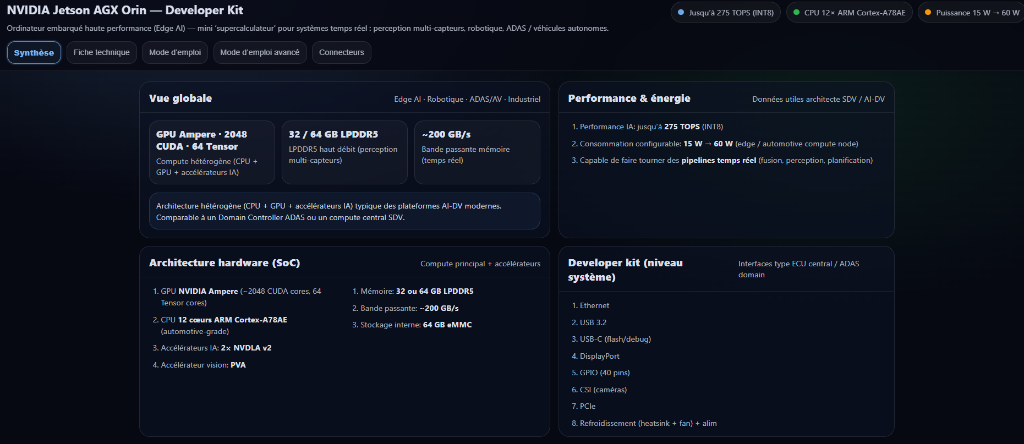
Jetson AGX Orin — summary
The NVIDIA Jetson AGX Orin — Developer Kit site presents a development platform for building and testing embedded AI, image processing, robotics and real-time systems applications.
Goal: understand the available hardware, interfaces, compute performance and the software tools needed to start developing on Jetson AGX Orin.
1. Kit overview
A high-performance embedded computer combining CPU + GPU + AI accelerators + memory + storage + I/O interfaces — a complete hardware base for prototyping before moving to dedicated electronics.
2. Hardware architecture
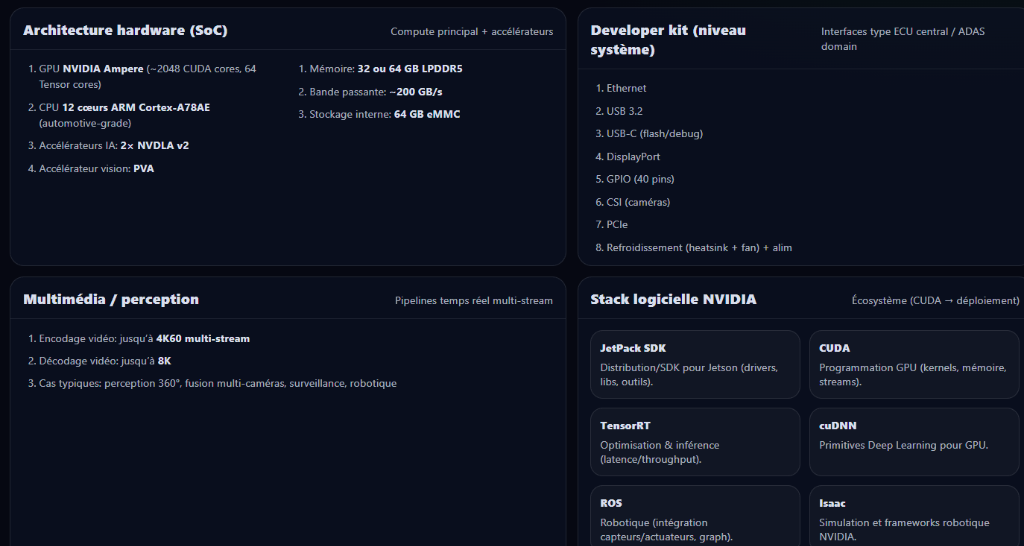
- CPU: 12-core ARM Cortex-A78AE (automotive-grade)
- GPU: NVIDIA Ampere (~2048 CUDA cores, 64 Tensor Cores)
- AI accelerators: 2× NVDLA v2
- Vision accelerator: PVA
- Memory: 32 or 64 GB LPDDR5 (~200 GB/s), 64 GB eMMC storage
Workload distribution: CPU → general processing, GPU → parallel compute, NVDLA/Tensor Cores → AI, PVA → vision.
3. Performance and power
Up to 275 TOPS in INT8, configurable power from 15 W to 60 W — lets you find the right performance / power / thermal trade-off for each application.
4. Connectivity and carrier board
Interfaces: Ethernet, USB 3.2, USB-C (flash/debug), DisplayPort, GPIO (40 pins), CSI cameras, PCIe — the interface level of a central ECU / ADAS domain controller.
5. Cameras and perception
Video encoding up to 4K60 multi-stream, decoding up to 8K — typical pipeline: Camera → Acquisition → Image processing → Neural network → Detection → Result (object detection, segmentation, tracking, camera fusion, 360°/3D perception).
6. The NVIDIA software stack
JetPack SDK (distribution/drivers/tools), CUDA (GPU compute), cuDNN (Deep Learning primitives), TensorRT (model optimization and inference), ROS and NVIDIA Isaac for robotics.
Chain: Jetson → JetPack → CUDA → AI framework → TensorRT → Application.
7. Getting started
Typical flow: set up the kit → connect power and peripherals → configure JetPack → connect sensors → develop → compile → run → measure → optimize. An advanced user guide covers deeper configurations (GPU performance, AI models, hardware interfaces).
8. Architecture positioning (SDV / AI-DV)
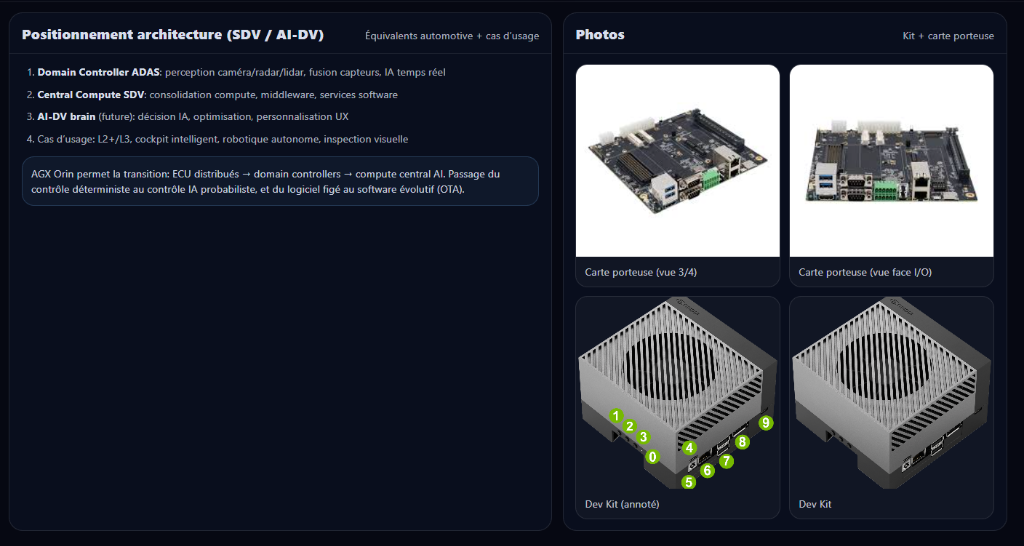
AGX Orin illustrates the transition from distributed ECUs → domain controllers → central AI compute: equivalent to an ADAS Domain Controller or an SDV central computer, for L2+/L3, smart cockpit, autonomous robotics and visual inspection use cases.
Prototyping cycle: Install → Connect → Program → Test → Measure → Optimize → Validate.
Screenshots